What to Expect During an MRI Scan
Key takeaways
- Most MRI scans take 20 to 45 minutes. Complex or multi-area scans can take up to 60 minutes.
- MRI is completely painless and uses no radiation. It works using strong magnetic fields and radio waves.
- The scanner is noisy, producing knocking, buzzing, and humming sounds at up to 100 decibels. You will be given headphones or earplugs.
- You must stay still during the scan. Movement blurs the images and may require sequences to be repeated.
- Claustrophobia is the most common concern. Open and open-bore scanners are available for patients who find closed scanners difficult.
- Every Mira scan includes two reports delivered within 3 working days: a medical report and a miraclarity report in plain English.
- You can return to normal activities immediately after the scan. There is no recovery time.
If you have never had an MRI scan, not knowing what to expect can cause unnecessary anxiety. The reality is straightforward: you lie still inside a scanner for 20 to 45 minutes while it takes detailed images of the inside of your body. The scan is painless, uses no radiation, and requires no recovery time. This guide walks you through exactly what happens before, during, and after an MRI, so you know how long an MRI takes and what the experience is actually like. If you are ready to book, schedule your scan with Mira in under 2 minutes.
How Long Does an MRI Take?
The length of an MRI scan depends on the body part being scanned and the number of imaging sequences required. Here is a breakdown of typical scan times.
| Scan Type | Typical Duration | Notes |
|---|---|---|
| Knee MRI | 25 - 35 minutes | Single joint, straightforward positioning |
| Shoulder MRI | 25 - 35 minutes | Single joint |
| Brain MRI | 25 - 40 minutes | Longer if contrast is used |
| Lumbar spine MRI | 25 - 35 minutes | Single spine region |
| Whole spine MRI | 45 - 60 minutes | Three spine regions in one session |
| Hip MRI | 25 - 35 minutes | Single joint |
| Ankle MRI | 25 - 35 minutes | Single joint |
| Abdomen MRI | 30 - 45 minutes | Multiple sequences, may require breath holds |
| Prostate mpMRI | 30 - 45 minutes | Multiparametric sequences with contrast |
| Full body MRI | 60 - 90 minutes | Multiple body regions scanned in sequence |
| Any scan with contrast | Add 10 - 15 minutes | Pre- and post-contrast sequences required |
These times cover the scanning itself. Plan to arrive 10 to 15 minutes early for check-in and safety screening, and allow 5 to 10 minutes after the scan for the radiographer to confirm all images are satisfactory.
Before the Scan: Check-In and Preparation
When you arrive for your MRI appointment, you will go through a series of standard steps before entering the scan room.
- Check in at reception and confirm your appointment details.
- Complete an MRI safety questionnaire. This asks about metal implants, pacemakers, previous surgeries, and any conditions that may affect the scan.
- A radiographer reviews your questionnaire and discusses any concerns. This is the time to mention claustrophobia, previous reactions to contrast, or any anxiety about the scan.
- You will be asked to remove all metal items: watches, jewellery, earrings, piercings, belt buckles, coins, keys, credit cards, hair clips, and glasses.
- If your clothing contains metal (zips, underwire bras, metal buttons), you will be given a hospital gown to change into.
- If your scan requires contrast, a small IV cannula is placed in your arm.
- You are taken to the scan room and positioned on the scanner table.
During the Scan: What Happens Inside the MRI
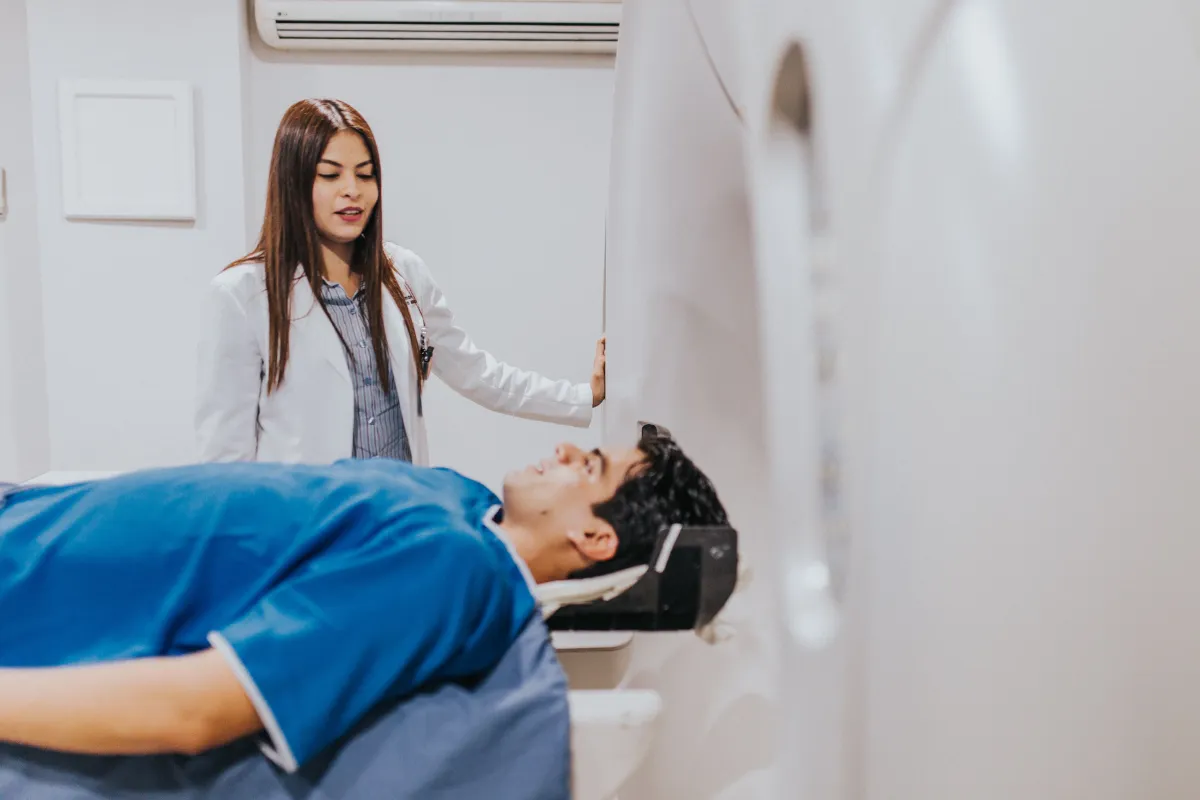
Once you are positioned on the scanner table, the radiographer slides the table into the MRI machine. What happens next depends on which body part is being scanned, but the general experience is consistent.
The Scanner
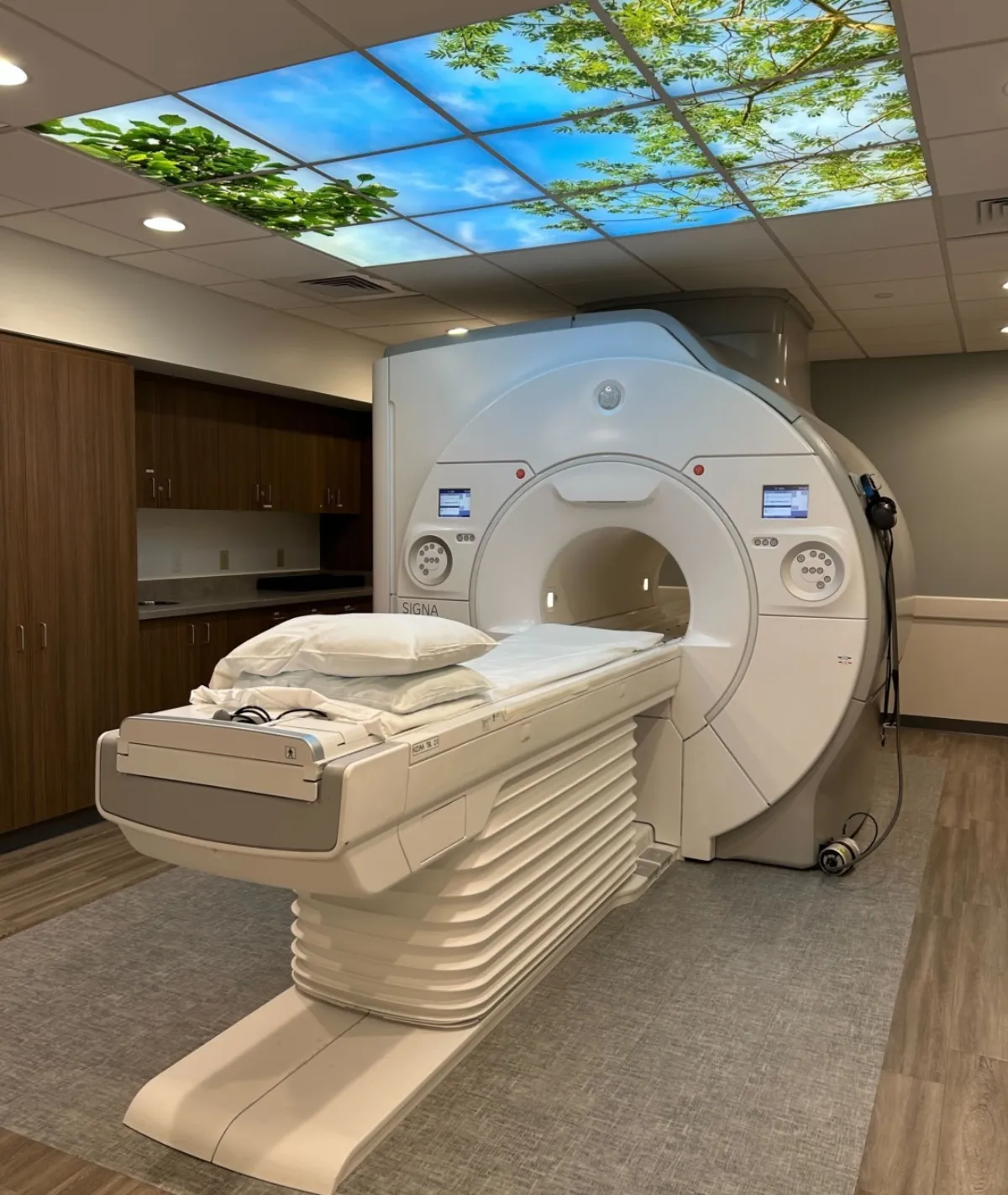
A standard closed MRI scanner is a large cylinder, roughly 60 to 70 cm in diameter, that you lie inside. The bore (the tunnel you enter) is typically about 60 cm wide. For most scans, the body part being scanned needs to be in the centre of the bore. For a brain MRI, your entire body is inside the scanner. For a knee or ankle MRI, only your lower half is inside, and your head remains outside.
The Noise
MRI scanners are loud. The knocking, buzzing, and humming sounds are caused by the rapid switching of magnetic field gradients inside the scanner. Sound levels can reach 100 decibels, similar to a power tool or a very loud concert. You will be given headphones or earplugs before the scan starts. Many centres allow you to listen to music through the headphones.
Staying Still
The most important thing during an MRI is to stay still. The scanner takes images in sequences, each lasting 2 to 7 minutes. Movement during a sequence blurs the images and may require that sequence to be repeated, extending the total scan time. Between sequences, you may hear brief pauses. The radiographer will communicate with you through an intercom to let you know how the scan is progressing.
Communication
You will have a call button or squeeze ball to alert the radiographer at any time. The radiographer can see you through a window and communicate through the intercom. If you feel uncomfortable or need a break, press the button and they will pause the scan.
Sensations During the Scan
- Warmth: You may feel a slight warming sensation in the area being scanned. This is normal and caused by the radiofrequency energy.
- Vibrations: Some patients feel mild vibrations or tingling, particularly during certain pulse sequences. This is harmless.
- Contrast injection: If contrast is used, you may feel a cool sensation in your arm during injection, followed by a brief metallic taste. These are common and temporary.
- Tapping: Some patients feel light tapping sensations in areas with metal dental work. This is caused by the magnetic field interacting with the metal and is not harmful.
Book Your MRI Scan
Private MRI from £369 (UK) or $369 (US). No referral needed. Two reports included. Results in 3 working days.
Book Your ScanClaustrophobia and MRI: How to Cope
Claustrophobia is the most common reason patients feel anxious about MRI. Studies suggest that 5% to 15% of patients experience some degree of claustrophobia during MRI, and approximately 2% are unable to complete the scan.
Strategies That Help
- Tell the team in advance. When you book your scan, mention claustrophobia so the team can prepare accordingly.
- Open or open-bore scanners: These have a wider bore or are open on the sides, providing more space. Our Spring location in Houston has one.
- Feet-first entry: For many scans (spine, hip, knee, ankle), you enter the scanner feet-first, keeping your head near the opening. Ask if this is possible for your scan.
- Close your eyes before entering the scanner and keep them closed throughout. Many patients find this significantly reduces anxiety.
- Breathing techniques: Slow, deep breaths help manage anxiety. Count your breaths to give your mind something to focus on.
- Bring a companion: A family member or friend can sit in the control room during your scan, visible through the window.
- Music: Most centres allow you to listen to music or an audiobook through headphones during the scan.
- Medication: If your claustrophobia is severe, your doctor can prescribe a short-acting anxiolytic (such as diazepam) to take before the scan. You will need someone to drive you home.
After the Scan: What Happens Next
When the scan is complete, the table slides out of the scanner and you are free to get up. If contrast was used, the IV cannula is removed. The entire post-scan process takes about 5 minutes.
- You can get dressed, collect your belongings, and leave the centre.
- You can drive, return to work, eat, drink, and exercise normally. There is no recovery time.
- If contrast was used, drink extra water over the next 24 hours to help your kidneys clear the gadolinium.
- If you took sedation medication, you will need someone to drive you home.
How MRI Works: The Basics
Understanding how MRI works can help reduce anxiety about the scan. MRI does not use X-rays or any form of ionising radiation. It is fundamentally different from CT scans or X-rays.
- Your body is made up mostly of water, which contains hydrogen atoms.
- The MRI scanner creates a strong magnetic field that aligns the hydrogen atoms in your body.
- The scanner sends radiofrequency pulses that temporarily disturb this alignment.
- As the hydrogen atoms return to their aligned state, they emit signals that the scanner detects.
- Different tissues (muscle, fat, bone marrow, fluid) emit different signals, creating contrast between structures.
- A computer processes these signals into detailed cross-sectional images.
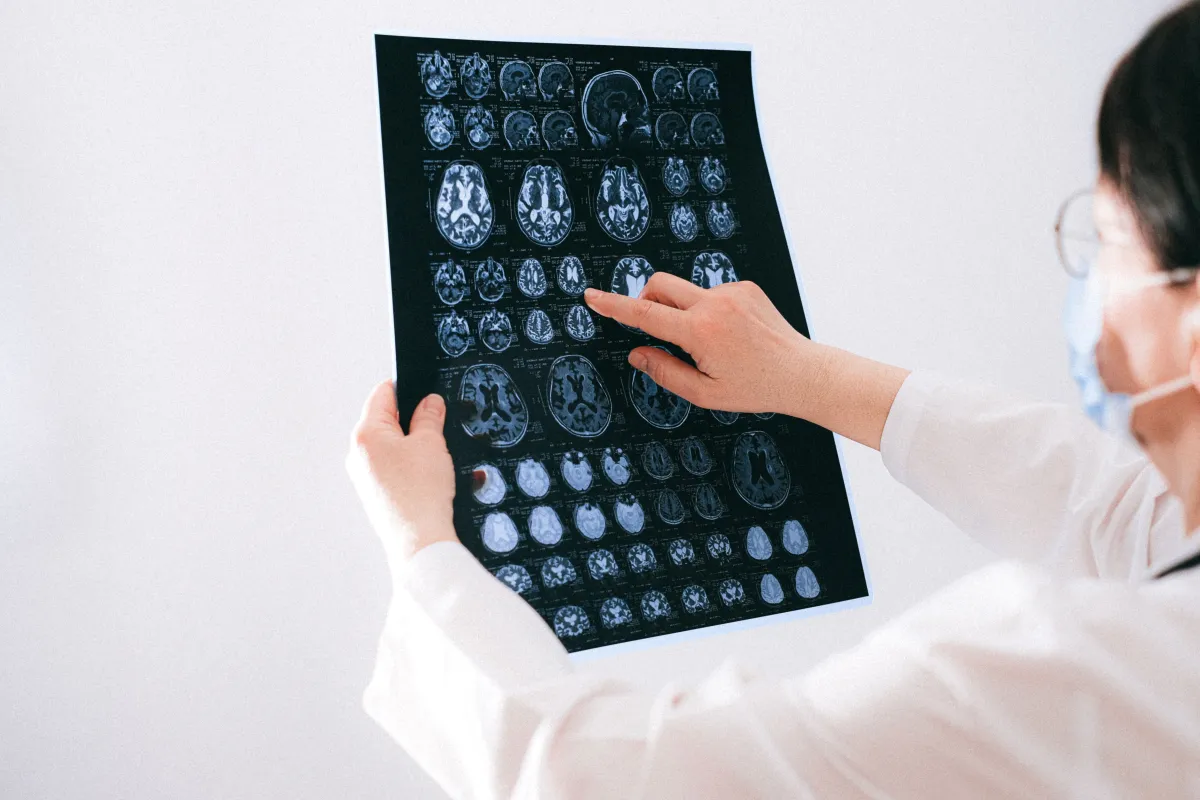
- The radiologist reads these images to identify normal anatomy and any abnormalities.
The strong magnetic field is always on, which is why metal must be removed before entering the scan room. The radiofrequency pulses are what create the loud knocking sounds.
MRI Scan Duration: Why Some Take Longer
Several factors can extend the duration of an MRI scan beyond the typical time range.
- Multiple body areas: Scanning the whole spine (cervical, thoracic, lumbar) takes longer than a single region.
- Contrast agent: Pre- and post-contrast sequences add 10 to 15 minutes to the total scan time.
- Repeat sequences: If you move during a sequence, the radiographer may need to repeat it.
- Complex pathology: If the radiologist sees something that needs additional sequences for characterisation, the radiographer may add extra views.
- Body habitus: Larger body sizes may require adjustments that add a few minutes.
- Multiparametric protocols: Prostate mpMRI and some cardiac MRI protocols use multiple specialised sequences that take longer than standard imaging.
Getting Your MRI Results
The speed of results varies significantly depending on where you have your scan.
| Provider | Typical Results Timeline |
|---|---|
| Mira Diagnostics | 3 working days - two reports (medical + miraclarity) |
| NHS (UK) | 2 to 6 weeks - sent to your GP, not directly to you |
| Private hospitals (UK) | 3 to 7 working days |
| US hospitals | 3 to 10 business days via patient portal |
| US imaging centres | 2 to 5 business days |
With Mira, you receive two reports within 3 working days. The medical report provides full clinical findings for your doctor. The miraclarity report explains every finding in plain English, with visual body guides showing where findings are located and severity indicators categorised as normal, monitor, or attention. Both reports are delivered digitally to your Mira account.
Is MRI Safe?
MRI is considered one of the safest medical imaging technologies available. It has been used clinically for over 40 years with no known long-term health effects from the magnetic fields used in standard clinical scanners.
- No radiation: MRI uses magnetic fields and radio waves. There is no ionising radiation, unlike CT or X-ray.
- No known long-term effects: Decades of clinical use have not revealed any long-term health consequences from MRI.
- Safe during pregnancy: While MRI is generally avoided in the first trimester as a precaution, it is considered safer than CT when imaging is clinically necessary during pregnancy.
- Contrast safety: Gadolinium contrast is very safe in patients with normal kidney function. Serious allergic reactions are extremely rare (fewer than 1 in 10,000).
- The main safety concern is metal: The strong magnetic field can attract ferromagnetic objects and interact with implanted devices. This is why metal screening is done before every scan.
MRI for Children: What Parents Should Know
Children may need MRI for many of the same reasons as adults: sports injuries, headaches, developmental concerns, or follow-up after treatment. The scan is the same, but the experience needs to be adapted.
- Explain the scan in age-appropriate terms. Describe the scanner as a "big camera" and the noise as "loud tapping."
- Let the child visit the centre beforehand if possible, so the environment is not completely unfamiliar.
- Most centres allow a parent to stay in the scan room (after metal screening) during the scan.
- Younger children (typically under 6) may need sedation or general anaesthesia to stay still. This is arranged through a specialist paediatric facility, not a standard imaging centre.
- Older children can often complete the scan with distraction techniques: audiobooks, music, or counting exercises.
- MRI is safe for children. There is no radiation, and there are no known age-related risks from the magnetic field.
Contact the Mira team before booking if you need a scan for a child, as paediatric MRI may require specific protocols and scheduling.
Ready to Book Your MRI?
Two reports with every scan - one for your doctor, one for you. Book online in under 2 minutes. Results in 3 working days.
Book Your ScanFrequently asked questions
How long does an MRI scan take?
Most MRI scans take 20 to 45 minutes. Simple joint scans (knee, shoulder) take 25 to 35 minutes. Brain and spine MRIs take 25 to 40 minutes. Full body scans take 60 to 90 minutes. Add 10 to 15 minutes if contrast is required.
Is an MRI scan painful?
No. MRI is completely painless. You lie still inside the scanner. The only sensation you may feel is slight warmth in the area being scanned and, if contrast is used, a cool feeling during injection. The scanner does not touch you.
Why is an MRI so loud?
The noise is caused by rapid switching of magnetic field gradients inside the scanner. These gradient coils vibrate against their supports, producing the characteristic knocking and buzzing sounds. Sound levels can reach 100 decibels.
Can I move during an MRI?
You should stay as still as possible during the scan. Movement blurs the images. Between sequences (every 2 to 7 minutes), there are brief pauses. If you need to adjust your position, tell the radiographer through the intercom.
What should I wear for an MRI?
Wear comfortable, loose-fitting clothing without metal zips, buttons, or fasteners. Athletic wear is ideal. If your clothing contains metal, you will be given a gown to change into.
Can I have an MRI if I am claustrophobic?
Yes. Strategies include closing your eyes before entering the scanner, listening to music, breathing exercises, entering feet-first (for many scans), and using open or open-bore scanners. Your doctor can also prescribe anxiolytic medication for severe claustrophobia.
Is MRI safe?
MRI is very safe. It uses no radiation and has no known long-term health effects. The main safety concern is metal: the strong magnetic field can interact with metal implants and attract metal objects. This is why thorough metal screening is done before every scan.
How long do MRI results take?
With Mira, you receive two reports within 3 working days. NHS results take 2 to 6 weeks. Other private providers typically take 3 to 7 working days.
Can I drive after an MRI?
Yes, unless you took sedation medication for claustrophobia. A standard MRI has no after-effects, and you can drive, work, and exercise immediately after.
Do I need a referral for an MRI?
With Mira in the UK, no referral is needed. Self-referral is accepted. In the US, no referral is needed to book, but a doctor order must be uploaded after booking (Texas requirement). This can come from your primary care physician.
Final thoughts
An MRI scan is a painless, radiation-free imaging study that takes 20 to 45 minutes for most body parts. The experience involves lying still inside a scanner while it produces detailed images. The scanner is loud but you will have hearing protection. Claustrophobia is manageable with the right strategies, and open scanner options are available.
With Mira, the process is straightforward: book online in under 2 minutes, attend your scan, and receive two reports within 3 working days. The miraclarity report ensures you understand your results in plain English. No GP referral needed (UK), no insurance paperwork (US). Book your MRI scan and take the first step toward answers.