Open vs Closed MRI: Which Should You Choose?
Key takeaways
- Closed MRI scanners produce the highest image quality and are preferred for most diagnostic scans. Field strength is typically 1.5T or 3T.
- Open MRI scanners are designed for patients with claustrophobia or larger body size. They are open on two or more sides.
- Open-bore (wide-bore) scanners are a middle ground: they have a wider tunnel than standard closed scanners while maintaining high field strength.
- Mira offers both open and closed scanner options at scanning centres. Houston has open MRI at Spring and open-bore at Dickinson.
- Image quality on modern high-field open scanners has improved significantly and is adequate for most routine diagnostic studies.
- Every Mira scan includes two reports: a medical report and a miraclarity report in plain English. Results in 3 working days.
- Your choice between open and closed MRI should be guided by the clinical question, your comfort needs, and your body size.
Choosing between an open MRI and a closed MRI is one of the most common questions patients have when booking a scan. Closed scanners produce sharper images but can trigger claustrophobia. Open scanners offer more space but have traditionally had lower image quality. Modern open-bore designs blur this line further. This guide compares all three scanner types so you can make the right choice. Book with Mira and select the scanner type that works best for you.
Open vs Closed MRI: Key Differences
The three main MRI scanner designs differ in their physical shape, magnetic field strength, and patient experience. Here is a direct comparison.
| Feature | Closed (Traditional) | Open-Bore (Wide-Bore) | Open MRI |
|---|---|---|---|
| Bore diameter | 55 - 60 cm | 70 - 75 cm | Open on 2+ sides (no tunnel) |
| Typical field strength | 1.5T or 3T | 1.5T or 3T | 0.2T - 1.2T (some high-field up to 1.5T) |
| Image quality | Highest | Very high (comparable to closed) | Good for most scans, lower for some specialist studies |
| Claustrophobia suitability | Most claustrophobia-triggering | Better - wider tunnel, more headroom | Best - open sides reduce enclosed feeling |
| Weight limit | 250 - 350 lbs (113 - 159 kg) | 350 - 550 lbs (159 - 250 kg) | 350 - 500 lbs (159 - 227 kg) |
| Scan time | Standard | Standard | Often 10-20% longer due to lower field strength |
| Noise level | Loud | Loud | Slightly quieter on low-field systems |
| Availability | Most common | Increasingly common | Less common, often at specialised centres |
How Closed MRI Scanners Work
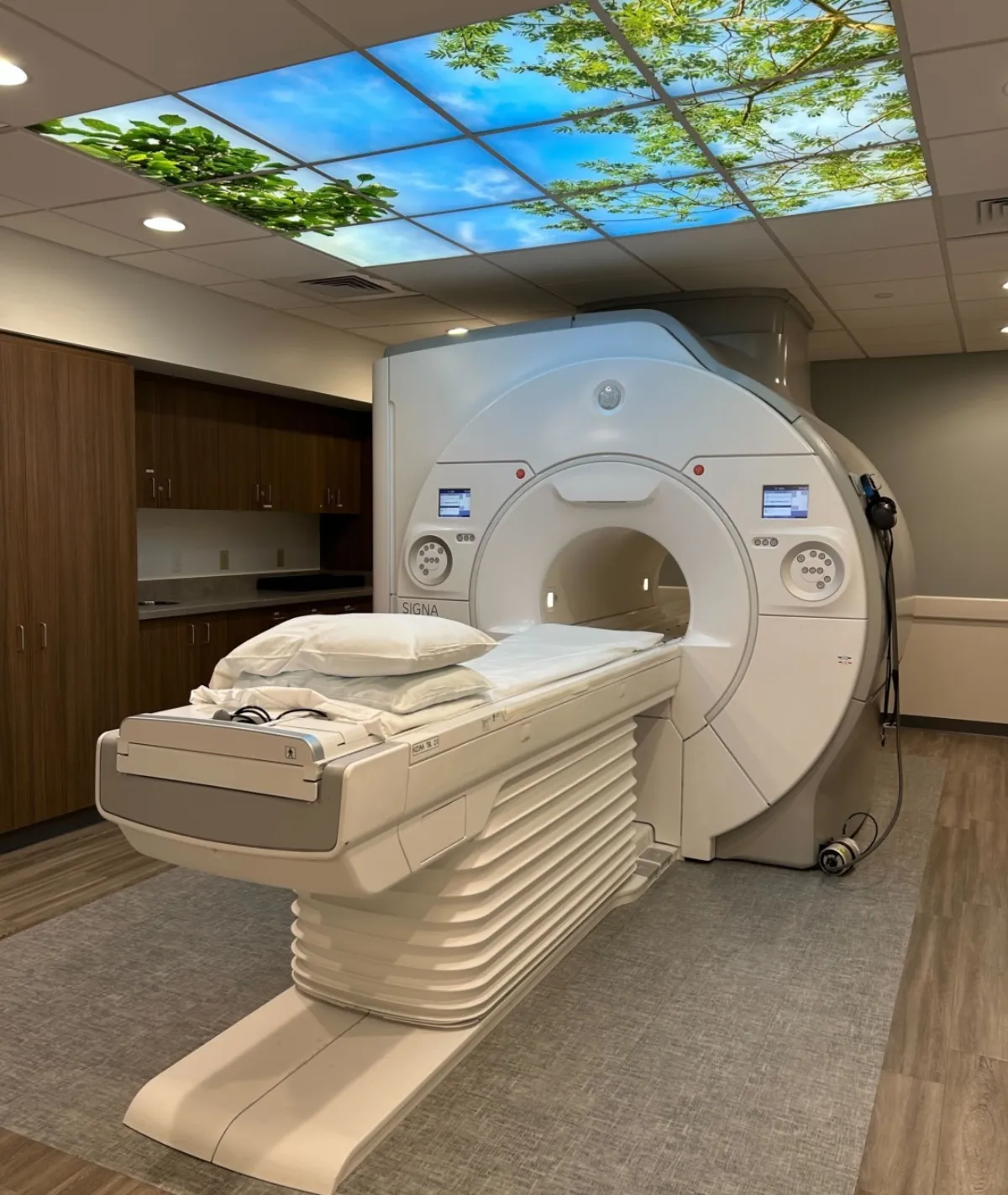
A closed MRI scanner is the traditional design that most people picture when they think of an MRI machine. It consists of a horizontal tube (bore) approximately 55 to 60 cm in diameter. You lie on a table that slides into the centre of this tube.
Advantages of Closed MRI
- Highest image quality: 1.5T and 3T field strengths produce the sharpest, most detailed images
- Best for complex studies: Brain, spine, prostate mpMRI, cardiac MRI, and any scan requiring multiple advanced sequences
- Fastest scan times: Higher field strength means faster signal acquisition, resulting in shorter scan durations
- Widest availability: Most hospitals and imaging centres use closed scanners, giving you the most appointment options
- Best for contrast studies: Contrast-enhanced imaging benefits from the higher signal-to-noise ratio of closed systems
Disadvantages of Closed MRI
- Claustrophobia: The narrow bore and enclosed design cause anxiety in 5% to 15% of patients. Approximately 2% cannot complete the scan.
- Size limitations: Standard closed scanners have weight limits of 250 to 350 lbs and bore diameters that may be tight for larger patients.
- Noise: Closed scanners at higher field strengths are louder than lower-field open systems.
How Open MRI Scanners Work
An open MRI scanner has a fundamentally different design. Instead of a closed tube, the magnet is positioned above and below the patient, with the sides open. You lie on a table between two flat magnetic plates.
Advantages of Open MRI
- Claustrophobia-friendly: The open design is significantly less anxiety-inducing. Patients can see out on both sides.
- Higher weight capacity: Open scanners typically accommodate patients up to 350 to 500 lbs.
- Comfortable for larger patients: No narrow tube to squeeze into.
- Child-friendly: Parents can sometimes stay close to the child during the scan.
- Positioning flexibility: Some open scanners allow upright or seated positioning for specialised studies.
Disadvantages of Open MRI
- Lower field strength: Traditional open scanners operate at 0.2T to 0.7T, compared to 1.5T or 3T for closed systems. This means lower image resolution.
- Longer scan times: Lower field strength requires longer acquisition times, extending the scan by 10% to 30%.
- Limited for some studies: Brain diffusion imaging, prostate mpMRI, cardiac MRI, and some other advanced protocols may not be feasible on low-field open systems.
- Less available: Fewer centres offer open MRI compared to standard closed scanners.
Modern high-field open scanners (1.0T to 1.5T) have closed much of the image quality gap. However, they are less common and more expensive to manufacture, so availability is limited.
Open-Bore MRI: The Middle Ground
Open-bore (also called wide-bore) MRI scanners represent a compromise between closed and open designs. They use the same cylindrical design as closed scanners but with a significantly wider bore: typically 70 to 75 cm compared to 55 to 60 cm.
- Image quality: Equivalent to standard closed scanners because they use the same field strength (1.5T or 3T).
- Comfort: The wider bore provides substantially more space. Most patients who are uncomfortable in standard closed scanners can tolerate an open-bore scanner.
- Weight capacity: Typically 350 to 550 lbs, higher than standard closed scanners.
- Advanced studies: Capable of all the same protocols as standard closed scanners, including brain, spine, prostate mpMRI, and cardiac imaging.
- Scan times: Same as standard closed scanners.
Open-bore scanners are increasingly common and represent the best option for patients who need high image quality but find standard closed scanners uncomfortable.
Book Your MRI Scan
Choose your preferred scanner type when booking. Mira offers closed, open, and open-bore options at scanning centres. From £369 (UK) / $369 (US).
Book Your ScanWhich Scanner Is Best for Your Scan?
The best scanner type depends on two factors: the clinical question (what your scan needs to show) and your comfort requirements.
| Scan Type | Recommended Scanner | Why |
|---|---|---|
| Knee MRI | Any (closed, open-bore, or open) | Musculoskeletal imaging is excellent on all scanner types |
| Shoulder MRI | Any | Standard musculoskeletal protocols work well on all systems |
| Brain MRI | Closed or open-bore preferred | Higher field strength provides better tissue contrast and diffusion imaging |
| Spine MRI | Any | Adequate on all systems for routine disc and nerve assessment |
| Prostate mpMRI | Closed or open-bore only | Requires 1.5T+ for multiparametric sequences |
| Cardiac MRI | Closed preferred | Requires high field strength and specific cardiac coils |
| Abdomen MRI | Closed or open-bore preferred | Breath-hold sequences benefit from faster acquisition at higher field |
| Full body MRI | Closed or open-bore | Multiple body regions require consistent high image quality |
For routine musculoskeletal scans (knee, shoulder, hip, ankle), all three scanner types produce diagnostically adequate images. For brain, abdominal, and specialist studies, closed or open-bore scanners are preferred.
MRI Scanner Options at Mira Locations
UK - Kent (Bluewater, Dartford)
Mira scans in Kent take place at Mira Scanning Centre, Bluewater, Dartford, which operates a clinical-grade MRI scanner. Contact the team or check at booking for specific scanner specifications and availability.
US - Houston
Mira operates three scanning centres across Houston, each with a different scanner type.
| Location | Scanner Type | Field Strength | Weight Limit |
|---|---|---|---|
| Central Houston (6300 Richmond Ave) | Closed MRI | 1.5T | 275 lbs |
| Spring (14405 Walters Rd) | Open MRI + High-Field | Varies | 350 lbs |
| Dickinson (Clear Lake area) | Closed MRI | 3T | 375 lbs |
If claustrophobia or weight is a concern, the Spring and Dickinson locations are the best options. If maximum image quality is the priority and you are comfortable in a closed scanner, the Central Houston location is excellent.
Claustrophobia and MRI: Practical Tips
If claustrophobia is your primary concern about MRI, you have more options than you might think.
- Try an open-bore scanner first: The wider bore solves the problem for most patients who struggle with standard closed scanners.
- Enter feet-first: For many scans (spine, hip, knee, ankle), you can enter the scanner feet-first, keeping your head near the opening.
- Close your eyes: Before the table moves into the scanner, close your eyes and keep them closed throughout. This prevents the visual trigger of seeing the bore walls close to your face.
- Use headphones with music: Engaging your auditory attention with music reduces the focus on the scanning environment.
- Breathing exercises: Slow, rhythmic breathing (4 counts in, 4 counts out) helps manage anxiety.
- Take a companion: Most centres allow a family member to sit in the control room, visible through the glass.
- Sedation: For severe claustrophobia, your doctor can prescribe a short-acting anxiolytic (diazepam or lorazepam). You will need someone to drive you home.
- Practice at home: Lie in a dark, quiet room with your eyes closed for 15 to 20 minutes to simulate the scan experience.
Open vs Closed MRI: Cost Comparison
The cost difference between open and closed MRI varies by provider and location.
- NHS (UK): Free regardless of scanner type, but you cannot choose your scanner.
- Private UK: Prices are generally the same regardless of scanner type. With Mira, scans start from £369.
- US hospitals: Costs are similar for both scanner types, though some hospital systems charge a premium for open MRI due to longer scan times.
- US imaging centres: Generally the same price. Mira offers all scanner types from $369.
With Mira, all scanner types are available at the same price point. Your choice should be based on clinical need and comfort, not cost.
Image Quality: Does It Matter For Your Scan?
The image quality difference between scanner types is real but often overstated for routine diagnostic scans.
- For routine knee, shoulder, hip, and ankle MRI: The image quality from any modern scanner (including lower-field open systems) is diagnostically sufficient. Radiologists regularly produce accurate diagnoses from 0.7T and above.
- For brain, spine, and abdomen: 1.5T or higher is preferred. Modern open-bore scanners at 1.5T produce identical quality to standard closed 1.5T systems.
- For specialist studies (prostate mpMRI, cardiac, diffusion imaging): 1.5T minimum, 3T preferred. Only closed or open-bore scanners are suitable.
The radiologist reading your scan is as important as the scanner itself. An experienced radiologist can produce an accurate diagnosis from images across all scanner types. All Mira scans are interpreted by consultant radiologists, and every scan comes with two reports delivered within 3 working days: a medical report and a miraclarity report in plain English.
Open vs Closed MRI: Scan Time Differences
One practical difference between scanner types that patients should be aware of is scan duration.
- Closed MRI (1.5T/3T): Fastest scan times. A knee MRI takes 25 to 35 minutes. Higher field strength means faster signal acquisition.
- Open-bore MRI (1.5T/3T): Same scan times as standard closed scanners because the field strength is identical.
- Open MRI (low-field, 0.2-0.7T): 10% to 30% longer scan times. A knee MRI that takes 30 minutes on a closed scanner may take 35 to 40 minutes on a low-field open system.
- The difference is usually 5 to 15 minutes per scan. For most patients, the comfort benefit of an open scanner outweighs the slightly longer scan time.
If scan duration is a concern (for example, if lying still is painful), an open-bore scanner at 1.5T offers the best combination of fast scan times and patient comfort.
Choose Your Scanner, Book Your Scan
Mira offers closed, open, and open-bore options. From £369 (UK) / $369 (US). Two reports in 3 working days. No referral needed.
Book Your MRIFrequently asked questions
What is the difference between open and closed MRI?
A closed MRI is a narrow tube you lie inside. An open MRI has an open design with the magnet above and below you, open on the sides. Closed scanners produce higher quality images. Open scanners are better for claustrophobia and larger patients.
Is open MRI image quality as good as closed?
Modern high-field open scanners (1.0T+) produce very good images, adequate for most routine diagnostic scans. Traditional low-field open scanners (0.2-0.7T) have lower image quality. For specialist studies like prostate mpMRI or cardiac MRI, closed or open-bore scanners at 1.5T+ are preferred.
What is an open-bore MRI?
An open-bore (wide-bore) MRI is a closed scanner design with a wider tunnel (70-75 cm vs 55-60 cm). It maintains the same field strength and image quality as standard closed scanners while offering more space for claustrophobic or larger patients.
Which MRI scanner is best for claustrophobia?
Open MRI is most comfortable for severely claustrophobic patients. Open-bore (wide-bore) scanners are a good middle ground, offering more space while maintaining high image quality. Other strategies include feet-first entry, closing eyes, music, and sedation medication.
Does Mira offer open MRI?
Yes. In Houston, Mira operates at Spring, which has both an open MRI and a high-field scanner. It is the only open option in the network. In the UK, contact the team for scanner availability at the Kent centre.
Is open MRI more expensive than closed?
With Mira, all scanner types are available at the same price: from £369 in the UK and from $369 in the US. Some hospital providers charge a premium for open MRI due to longer scan times.
Can I get a brain MRI on an open scanner?
Yes, but a closed or open-bore scanner at 1.5T or higher is preferred for brain MRI. The higher field strength provides better tissue contrast and enables advanced sequences like diffusion-weighted imaging.
What weight limit do open MRI scanners have?
Open MRI scanners typically accommodate patients up to 350 to 500 lbs (159 to 227 kg). Open-bore scanners range from 350 to 550 lbs (159 to 250 kg). Standard closed scanners are limited to 250 to 350 lbs (113 to 159 kg).
Can children use open MRI?
Yes. Open MRI is often preferred for children because the open design is less frightening. Some centres allow a parent to stay near the child during the scan on an open system.
How do I choose between open and closed MRI?
Consider the clinical question (what your scan needs to show) and your comfort level. For routine musculoskeletal scans, any scanner works. For brain, prostate, or cardiac scans, closed or open-bore is preferred. If claustrophobia is a concern, try open-bore first.
Final thoughts
The choice between open and closed MRI comes down to balancing image quality with patient comfort. Closed scanners produce the sharpest images and are preferred for complex studies. Open scanners solve the claustrophobia problem. Open-bore scanners offer the best of both worlds for most patients.
Mira provides access to all three scanner types at scanning centres. Every scan, regardless of scanner type, includes two reports delivered within 3 working days: a medical report for your doctor and a miraclarity report that explains your findings in plain English. No referral needed (UK), no insurance required (US). Book your MRI and choose the scanner that works best for you.